
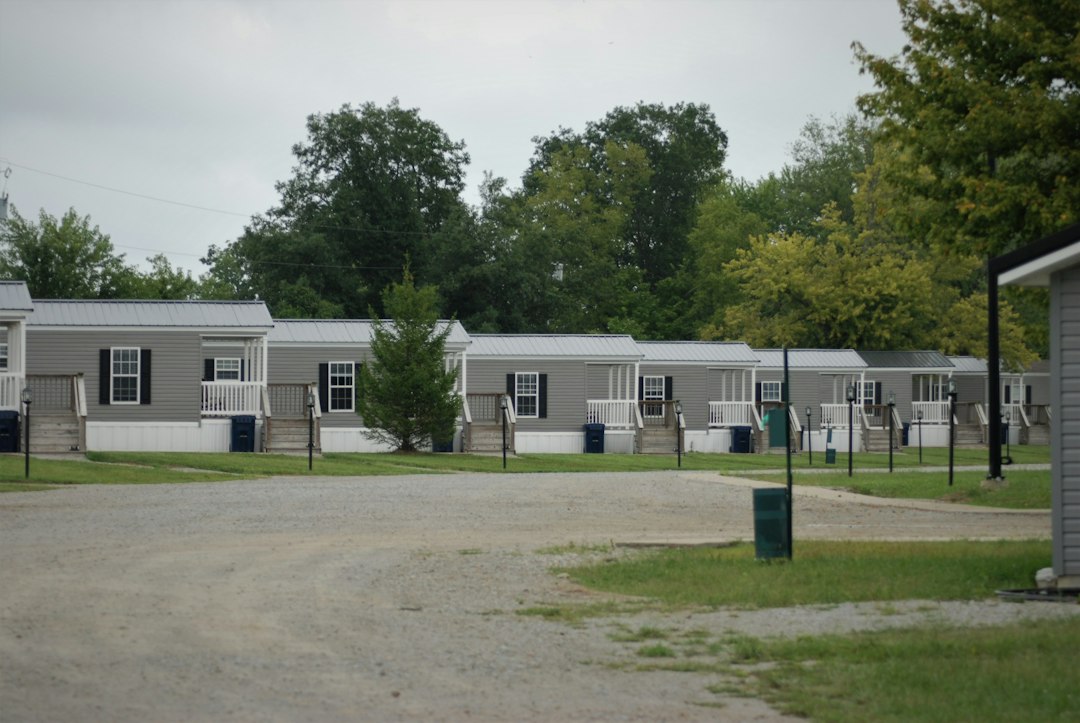
Wholesaling mobile homes works like any wholesale deal on paper: you put a home under contract below what a buyer will pay, then assign the contract or resell it for a fee. Wholesaling mobile homes also differs from house wholesaling in three ways that cost beginners money: many of these homes are titled like vehicles instead of deeded like houses, a park manager often has to approve your buyer, and states such as Texas and Florida tie dealer or broker licensing to as few as one or two sales a year.
Below: what you are buying, how titles work in Texas, Florida and California, the three deal types, the licensing rules, and two worked hypothetical deals. New to wholesaling? Start with how to wholesale real estate.
Those price figures come from the Census Bureau’s Manufactured Housing Survey (via FRED, as of October 2026), and cover new HUD-code homes only. The used homes you will wholesale sell for far less.
Mobile home or manufactured home? The June 15, 1976 line
People use the terms interchangeably, but the legal line is a date. According to HUD, every manufactured home built in the U.S. after June 15, 1976 must be certified by its manufacturer as meeting the federal construction and safety standards, known as the HUD Code, found at 24 CFR Part 3280. Homes built before that date are “mobile homes” in the strict sense and were never built to the federal code.
Two pieces of evidence prove which one you are looking at:
- The certification label (HUD tag). A red label on the exterior of each transportable section; a double-wide has two. Photograph them on your first visit.
- The data plate. Under 24 CFR 3280.5 it is affixed near the main electrical panel and lists the manufacturer, serial number, model and date of manufacture, plus the wind, roof-load and thermal zone maps the home was built for.
Why it matters to a wholesaler: pre-1976 homes are hard to finance, many parks refuse to accept them, and some local codes block moving them in.
Personal property or real property: the title decides the deal
A house is real estate, transferred by deed and recorded at the county. A manufactured home starts life as personal property (chattel), titled through a state agency, often the DMV or a housing department. It stays chattel until the owner goes through the state’s conversion process, which usually requires owning the land (or holding a long-term lease) and permanently affixing the home. The rules and the agency differ by state:
| State | Who titles the home | How it becomes real property | Dealer/broker license trigger |
|---|---|---|---|
| Texas | TDHCA Manufactured Housing Division issues a Statement of Ownership (not a “title”) | Owner elects real property status; home must be attached to land the owner owns or holds under a qualifying long-term lease; certified Statement of Ownership filed in county real property records within 60 days (Tex. Occ. Code 1201.2055) | Retailer license to sell or offer two or more homes to consumers in 12 months; broker license to negotiate two or more (Tex. Occ. Code 1201.003, 1201.101) |
| Florida | FLHSMV certificate of title | Owner of the land records the original title, legal description and sworn statement with the county clerk, then applies to FLHSMV to retire the title (Fla. Stat. 319.261); home taxed as real property carries an “RP” sticker (Fla. Stat. 320.0815) | Buying, selling, or acting as agent for one or more mobile homes in 12 months creates a presumption of being a dealer (Fla. Stat. 320.77) |
| California | Dept. of Housing and Community Development (HCD) | Home installed on a permitted foundation system; local agency records form HCD 433A with the county recorder; HCD cancels the title record (Health & Safety Code 18551) | No unit count; anyone in the business of selling or brokering homes for a fee is a dealer, with an exclusion for licensed real estate brokers handling eligible sales (H&S Code 18002.6) |
Texas sources: TDHCA’s Statement of Ownership FAQ. Florida: Fla. Stat. 319.261 and Fla. Stat. 320.77. California: HCD’s foundation conversion guide and H&S Code 18002.6. Other states have their own versions, so check your state’s agency before you write a contract. Our state-by-state wholesaling guides are a starting point.
The practical rule: never assume a home sitting on land is part of that land. A double-wide on five acres can still carry a separate title, with its own lienholder, that the county deed search will never show you.
The three deal types and how each one closes
| Deal type | What transfers | Where liens show up | Typical buyer | Main risk |
|---|---|---|---|---|
| Home in a park (rented lot) | Home title only, at the state agency; buyer signs a new lot lease | State title record | Landlords, park owners, owner-occupants | Park rejects your buyer or the home |
| Home + land, converted | Deed at the county (home is part of the land) | County records | Owner-occupants with mortgages, rehabbers | Conversion paperwork never finished |
| Home + land, not converted | Deed for land plus separate home title | County records and state title record | Cash rehabbers, landlords | Missed lien on the home title |
| Land-only infill lot | Deed | County records | Dealers, investors who set new homes | Zoning bans manufactured homes |
Land-only infill means wholesaling vacant lots where a new home can be placed. Buyers care about utilities, road access and zoning; the mechanics are in our guide to wholesaling land.
Dealer and broker licensing: where wholesalers get caught
Mobile home wholesalers face a second set of licensing rules, written for dealers, and the thresholds are low.
- Texas requires a retailer license to sell or exchange, or offer to sell or exchange, two or more manufactured homes to consumers in a 12-month period, and a broker license to negotiate those contracts for others at the same count.
- Florida presumes you are a dealer if you buy, sell, deal in, or act as agent for the sale of one or more mobile homes in a 12-month period. Its “mobile home broker” definition includes someone who acts as an intermediary for a seller of a used mobile home or helps the seller find a buyer, which describes a wholesaler’s assignment almost word for word.
- California has no unit count. If you are in the business of selling or brokering homes and collect a fee, you are a dealer unless an exclusion applies, such as a licensed real estate broker handling a sale allowed under Business and Professions Code 10131.6.
Assigning instead of taking title does not obviously exempt you, since several definitions reach anyone who “offers” or “negotiates” a sale. Read your state’s statute, call the agency, and pick a path: get licensed, partner with a licensed retailer or broker, or stay under the trigger. Our guide to real estate licensing for wholesalers covers the real property side of the same question.
How assigning a titled home differs from assigning a deed
With a chattel home, the “title search” happens at the state agency, and many sellers close with a signed title and bill of sale instead of a closing table. That is where deals go wrong. Work this checklist:
- Get the title or ownership record before you sign. Match the serial and HUD label numbers on the home to it.
- Check liens at the agency. In Texas, liens on a personal property home are recorded with TDHCA, not the county. A seller who “lost the title” may have a lender holding it.
- Check taxes and registration. TDHCA, for example, may require a tax certificate showing no taxes due for some relocations. In Florida, an affixed home not taxed as real property is issued a mobile home sticker rather than an “RP” sticker.
- Write the contract for chattel. Name the home by serial number and allow assignment. See the wholesale contract walkthrough for the clauses that carry over.
- Close through a neutral party. Some title companies and attorneys handle chattel closings; an investor-friendly title company may know who does. Hold buyer funds with a third party until the signed title is in hand.
- File the transfer on time. Texas requires a Statement of Ownership application within 60 days of a sale, and ownership does not change at the department until it is filed.
Park approval, lot rent and park rules
On a rented lot, the park is a third party to every deal. Most parks require the new owner to apply, and many screen credit and income. Some restrict rentals, which kills a landlord buyer. Ask the park office before you offer:
- What is current lot rent, and when was the last increase?
- Does the seller owe back lot rent or fees? (It usually must be paid before transfer.)
- Are rentals allowed, and does the park buy homes itself?
- Is there an age or condition rule for homes staying in the park after a sale?
- How long does buyer approval take?
Lot rent sets value in a park: buyers pay less for an identical home with higher rent. Make park approval of your buyer a condition of your seller contract, so a rejection does not leave you in breach.
Valuing a mobile home without fooling yourself
House comps rarely work, and park homes often sell off-market. Use three inputs:
- Same-park sales. The park manager and long-time residents know what homes sold for. This is the best comp you will get.
- A guide value. J.D. Power’s MH Connect for Used Homes is the guide most people still call “NADA” (J.D. Power acquired those guides). It values used manufactured and pre-HUD mobile homes, with adjustments for condition and land-lease communities, and lenders use it.
- Buyer feedback. What your landlords and park owners pay is the ceiling for your contract price.
For homes on owned land that are converted to real property, conventional comps and ARV methods apply, and you can run the numbers through the MAO calculator.
Inspection: four places the money hides
- Roof. Look for ceiling stains and sagging panels; older metal roofs leak at seams.
- Subfloor. Soft spots around tubs, toilets, water heaters and doors usually mean a long-running leak.
- Plumbing. Pull a skirting panel; check supply lines, pipe type and the belly wrap under the floor.
- Frame, piers and tie-downs. Piers should be plumb, the home level, straps tight. Sticking doors and cracks at a double-wide’s marriage line point to setup problems.
Price repairs with our repair estimating guide, remembering the ceiling is lower: a floor-and-plumbing job can consume a park home’s whole margin.
Who buys when you are wholesaling mobile homes
- Park owners buying to fill lots or rent. Fast, but they know true values.
- Landlords renting park homes or home-and-land properties.
- Owner-occupants seeking affordable housing, often needing financing or seller terms.
- Chattel-financed buyers. In a May 2021 report on loan data, the CFPB found around 42% of manufactured home purchase loans were chattel loans, secured by the home but not the land, with higher interest rates and fewer protections than mortgages.
Build this list before you sign anything; our guide to finding cash buyers before your first deal applies, plus asking every park office whether ownership buys homes.
Two hypothetical deals, worked through
Hypothetical deal 1: a park home assignment
A seller is moving out of state and owns a 1998 single-wide in a park with lot rent of $600 a month (hypothetical). She owes two months of back rent, $1,200. Same-park sales of similar homes ran $26,000 to $30,000, and a local landlord buyer tells you he pays about $15,000 for homes that need flooring and a water heater, which this one does. Every figure here is hypothetical.
- Contract price to seller: $11,000, with $1,200 of back rent paid from the proceeds at closing
- Assignment price to landlord buyer: $14,500
- Hypothetical assignment fee: $3,500
- Contingencies: park approves the buyer; title is free of liens; serial number matches
The landlord is approved by the park and closes through a third party holding funds until the title is signed over. In Texas or Florida this sale may count toward the licensing trigger, so this hypothetical wholesaler works with a licensed partner. On why park-home fees stay small, see how assignment fees are set for why buyers push back on large ones.
Hypothetical deal 2: a double-wide on owned land
A 2004 double-wide on 1.5 acres. The county shows a deed, and the seller says the home was converted to real property. Comparable home-and-land sales support an ARV of $165,000 and repairs estimate at $25,000 (both hypothetical). Using the 70% rule: $165,000 x 0.70 = $115,500, minus $25,000 repairs = $90,500 maximum for the end buyer. You contract at $80,000 and assign at $90,000, a hypothetical $10,000 fee.
The title company finds the conversion was never recorded; the home still has a separate title with a chattel lien. The deal survives because the contract required a clear home title or completed conversion. The seller pays off the lien at closing and the conversion is filed.
When a free-and-clear seller wants top price, seller financing can bridge the gap for an owner-occupant who cannot get a mortgage.
When mobile home wholesaling is the wrong move
- Your state licenses on the first or second sale and you have no licensed partner.
- The spread is too thin. On a $12,000 home, one missed repair wipes out the fee, and house-sized marketing budgets do not fit.
- The park controls the exit. If the park refuses older homes, rejects most applicants, or buys every home itself at a low price, there is no second buyer.
- The seller is not the titled owner. Heir and “never transferred it” situations take months at the agency.
- The home has to be moved. Moving and setup costs usually exceed what a wholesale buyer will absorb.
Many beginners do better starting with houses or land. The traps mirror our wholesaling mistakes guide, made more expensive by the paperwork.
Wholesaling mobile homes: FAQ
Can you wholesale a mobile home without a license?
It depends on the state and your volume. Texas licenses retailers and brokers at two or more homes to consumers in 12 months, Florida presumes dealer status at one or more, and California applies its dealer definition to anyone in the business for a fee. Check your state’s dealer statute before your first deal.
How do I tell whether a home is real property?
Ask for the conversion record (in Texas, a recorded Statement of Ownership showing the real property election; in California, a recorded HCD 433A; in Florida, a retired title recorded with the county). Then confirm with the titling agency that no active title remains.
Can a pre-1976 mobile home be wholesaled?
Yes, but expect mostly cash buyers, and some parks will not allow them. Price it off what those buyers pay.
Who pays the back lot rent?
Usually the seller, out of the sale proceeds, because most parks will not approve a transfer with a balance owed. Put it in the contract.
Keep building your wholesaling toolkit
Run your first manufactured home deal with the right paperwork
Get the free starter kit: a deal analyzer to price park and land deals, starter contracts you can adapt for chattel homes, a seller script, and a buyer’s list checklist for landlords and park owners.